2015-09-13

Agfa Isoflash Rapid


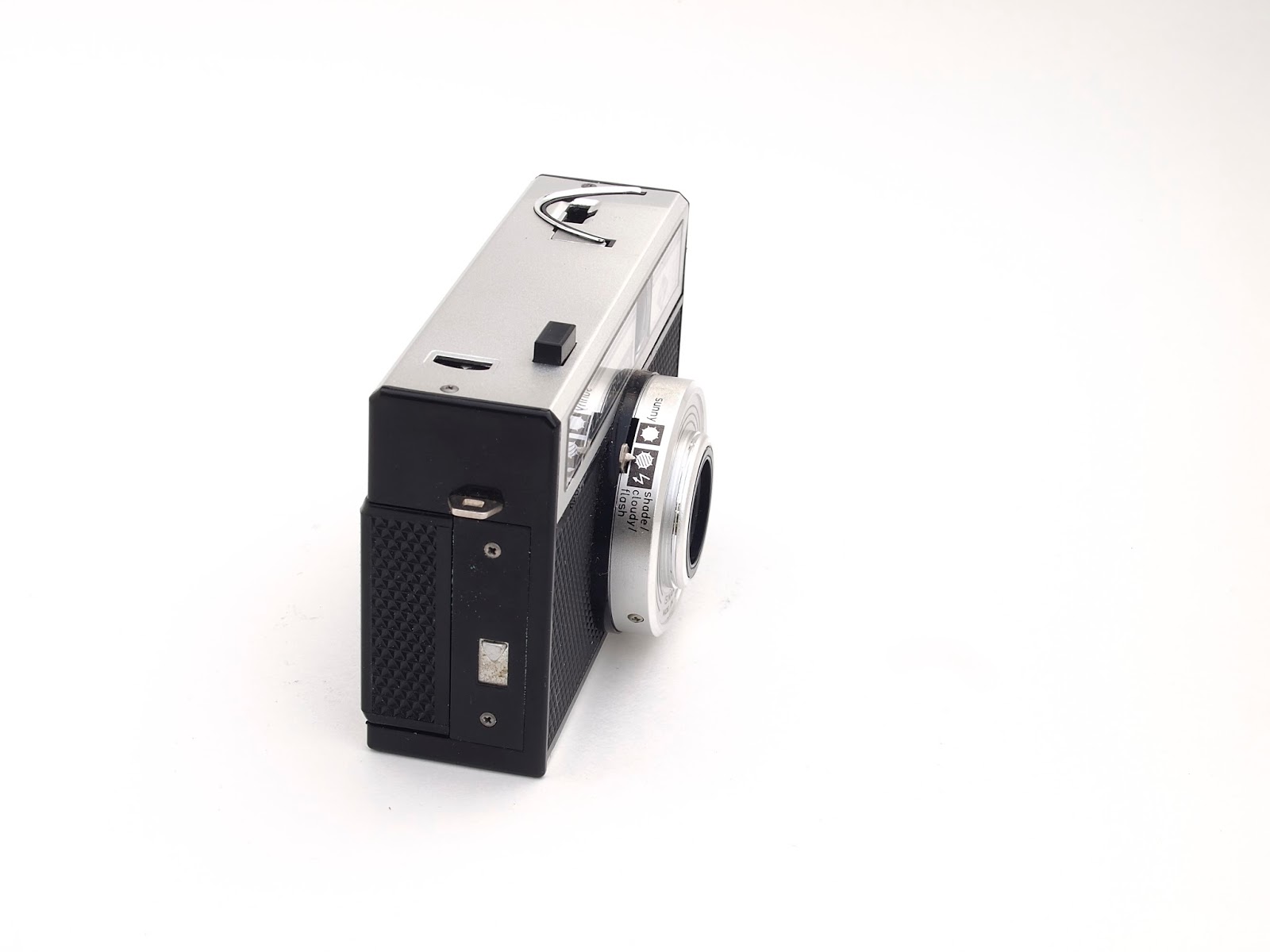
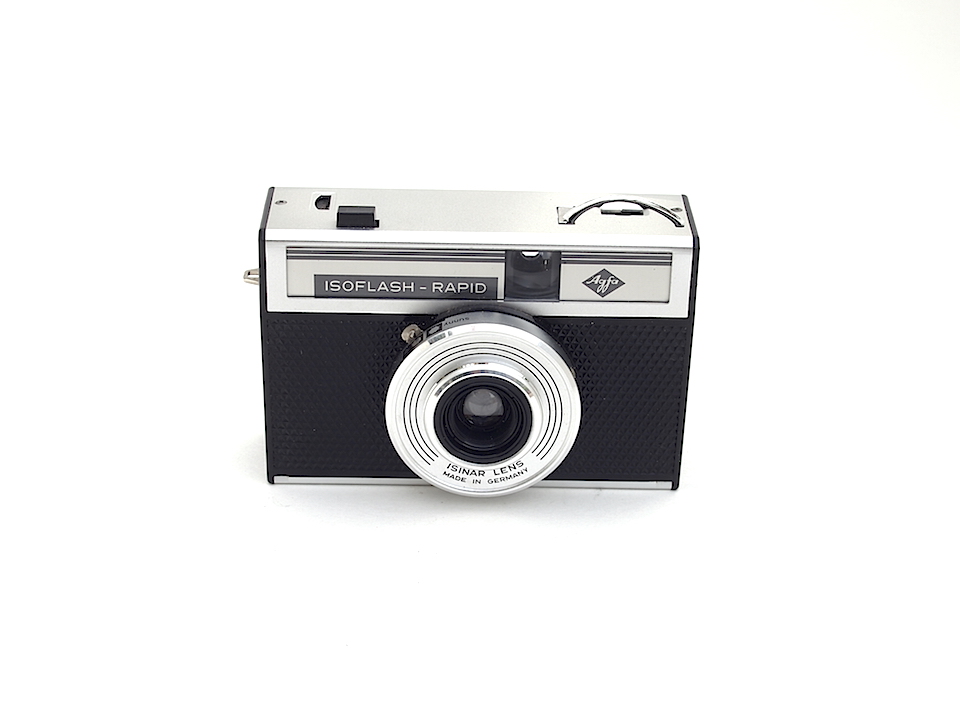
Nach so vielen Instamatic (126er) Kameras hier Agfa's Antwort. Vielmehr eher eine Verlegenheitsantwort, denn Kodak hatte Agfa 1963 wohl kalt erwischt. Daher besann man sich bei Agfa ihrer Karat-Kassette aus den 1930ern und spendierte ihr noch eine "Nase" mit der man Kameras die Filmempfindlichkeit mitteilen konnte. 1965 kam das System (wieder) auf den Markt und das gleich mit einer Serie einfacher Kameras aus Agfa's Münchener Kamerawerk. In Größe und Eigenschaftsprofil gleichen die Kameras der Konkurrenz von Kodak doch sehr. 
After so many Instamatic (126) cameras, here comes Agfa's answer to this easy-load cartridge. It was rather a stopgap answer, Kodak obviously caught Agfa with their pants down. Agfa remembered its Karat cartridge from the mid 30ies, and just added a nose to convey film speed information to the (equiped) cameras. Agfa (re-) launched the system on the market in 1965 together with a series of simple cameras from their camera production plant in Munich. Size and feature set resemble Kodak's Instamatic versions quite a bit, though.
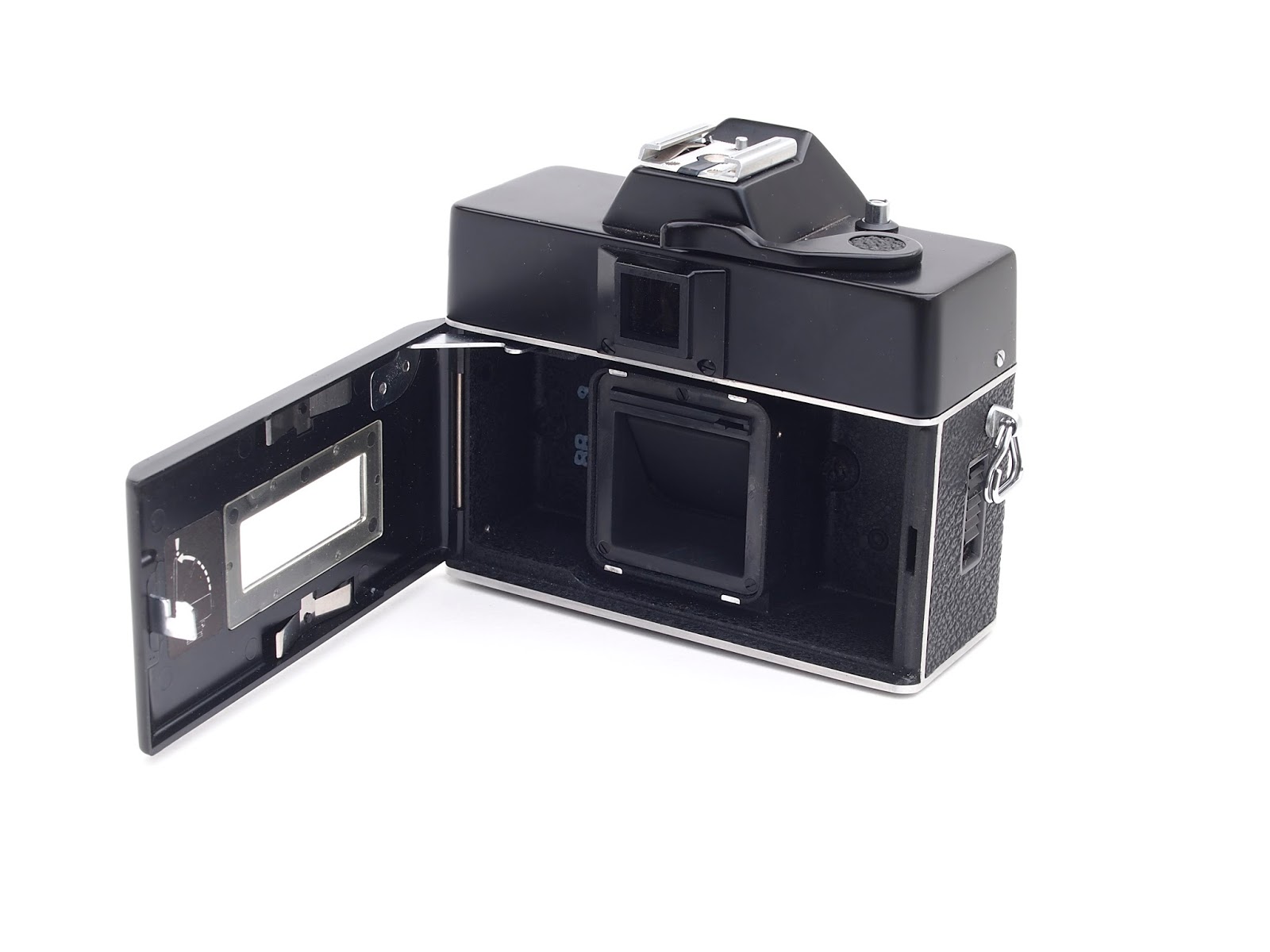
Ich habe meine Isoflash-Rapid als komplettes Set bei einem Trödelhändler in Astoria, Oregon für nur $20 gefunden. Und es scheint tatsächlich umbenutzt seit 50 Jahren. Der mitgelieferte, originalverpackte Film hat als Ablaufdatum August 1968, die Batterie zum Zünden der Blitzbirnchen ist wohl nicht mehr zu gebrauchen. Neben der ausführlichen Gebrauchsanleitung findet sich noch "easy load instructions" im Inneren der Kamera.
I got my Isoflash-Rapid camera as a complete outfit from an antique store in Astoria, Oregon for just $20. The outfit seems to be unused since 50 years. The roll of film included expired in August 1968, the battery for powering the flash bulbs is probably dead. Besides the comprehensive manual there were "easy load instructions" inside the camera.
Agfa war wohl bewusst, dass wirkliches, idiotensicheres "Easy Load" nur die Kassette von Kodak bot. Rapid war zwar grundsätzlich einfacher zu laden als die 135er Patrone und man brauchte nicht zurückspulen. Allerdings war es schon etwas fummeliger und es bestand immer die Gefahr, dass belichteter Film ein zweites Mal eingelegt werden konnte. Agfa wies daher sehr deutlich auf den größten (und fast einzigen) Nachteil der Instamatik-Kassette hin: die mangelhafte Filmplanlage und den damit verbundenen Schärfeverlust (siehe Bild unten von der Verpackung). Genutzt hat es nichts, denn die billigen und einfachen Kameras mit ihren lichtschwachen Objektiven profitierten ja nicht wirklich von einer Filmandruckplatte. Agfa schwenkte dann auch schon 1968 um, kaufte eine Lizenz von Kodak und stellte selbst Kameras und Film für die 126er Kassette (hier Pak genannt) her. In den frühen 70ern dann sogar sehr erfolgreich mit der Agfamatic Serie, meine erste Kamera war so eine
Agfa must have known, that real and fool-proof "easy load" was only offered by Kodak's Instamatic cartridge. Obviously, the Rapid film was generally easier to handle than a 135 roll and rewind was not necessary. However, it was more fiddly and there was always the threat that already exposed film could be used a second time. Therefore, Agfa pointed distinctly to the biggest (and almost only) disadvantage of the Kodak cartridge: the insufficient film flatness and the respective loss of sharpness (see picture of the packaging below). It was of no avail. The simple and cheap cameras with their low f-stop lenses from both systems wouldn't really benefit from a film pressure plate. After limited success on the market, Agfa changed their mind already in 1968 and started making film and cameras for the 126 cartridge (named PAK at Agfa). During the early 1970ies they have been quite successful with the Agfamatic series. My very first camera was a Agfamatic 200
Interessanterweise konnte Agfa einige andere Hersteller überzeugen, auch Kameras für die Rapid-Kassette zu bauen. Es sind sogar einige ganz schicke mit ein bisschen fotografischem Anspruch dabei (z.B. Fujica Rapid S2 oder Minolta 24 Rapid), allerdings keine Spiegelreflex, obwohl einer solchen eine Filmandruckplatte sehr gut gestanden hätte.
Ich werde natürlich das Set in seinem Zustand bewahren und den Film nicht verwenden. Wenn ich aber mal eine zweite Rapid (oder SL) Kassette finde (oder gar einen unbelichteten Film), werde ich wohl richtig fotografieren. 35mm Film läßt sich nämlich recht einfach umspulen, siehe Links unten.
Interestingly, Agfa was able to convice some other manufacturers to produce own cameras for the format. There are even some really nice with some photographic ambitions (eg. Fujica Rapid S2 oder Minolta 24 Rapid). However, no SLR, although this could have made use of the film pressure plate.
I will of course keep the complete outfit in its actual form and don't use the film. However, if I ever find a second Rapid (or SL) cartridge (or an unexposed film roll), I will shoot a roll with the camera. 35 mm film can be easily reloaded, see links below.

Datenblatt einfache Sucherkamera mit für Rapid-Film
Objektiv Agfa Isinar (einlinsiger Meniskus, 40 mm f/8)
Verschluss Agfa Parator (1/40 und 1/80 s)
Film (format) 24 x 24 mm, Agfa Rapid Kassette, 16 Aufnahmen
Fokussierung Fixfocus
Sucher einfacher Sucher ohne Rahmen
Blitz AG-1(B) Blitzbirnchen, versenkbarer Reflektor
Filmtransport mittels Daumenrad, Rückspulen nicht notwendig
sonst. Ausstattung Bildzählwerk (rückwärts), Stativgewinde
Maße, Gewicht                                                                                                                
Batterie PX-23 (6V Quecksilber), nur für Blitz notwendig
Baujahr(e) 1965-1966
Kaufpreis, Wert heute 65 DM, US$15 (1965), $10-$20
Links Camerosity-Blog, Lomography Magazine
Data Sheet simple point&shoot camera for Rapid film
Lens Agfa Isinar (single lens meniscus, 40 mm f/8)
Shutter Agfa Parator (1/40 and 1/80 s)
Film (format) 24 x 24 mm (1" x 1")
Focussing Fixfocus
Viewfinder simple viewfinder without frame
Flash AG-1(B) flash bulbs, retractable reflector
Film advance with thumb wheel, no rewind necessary
misc. Features frame counter (backwards), tripod socket
Size, Weight                                                                                                               
Battery PX-23 (6V Mercury), only to power flash bulbs
Year(s) of Production 1965-1966
Original Price, Today's Value US$15 (1965), $10-$20
Links Camerosity-Blog, Lomography Magazine

2015-09-01

Pentax Spotmatic F

Mit der Pentax Spotmatic F von 1973 stattete Asahi Optical ihre Spotmatic endlich mit Offenblend-Messung aus, sage und schreibe 10 Jahre nach der Topcon RE Super, die Pentax damals den ersten Platz bei der TTL Messung weggeschnappt hatte, damals schon bei offener Blende. Auch die großen Konkurrenten von Pentax hatten Offenblend-Messung schon lange im Programm: Nikkormat FT (1965), Minolta SR-T 101 (1966), Canon FTb (1971). Vielleicht lag es am "universellen" M42-Schraubgewinde, was Asahi vielleicht nicht ohne Absprache mit den anderen Herstellern eigenmächtig abändern wollte. Aber schon Praktica hatte 1969 die LLC auf den Markt gebracht, Offenblend-Messung mit elektrischer Übertragung der Blendeninformation! Asahi Optical löste es mechanisch und führte die neuen Objektive zusammen mit dem Super-Multi-Coating (SMC) ein. Das war schon 1971 passiert zusammen mit dem Zeitautomaten Spotmatic ES.
In 1973, Asahi Optical launched the Pentax Spotmatic F, which finally added open-aperture-metering to the famous Spotmatic series. Believe it or not, this was 10 years after Topcon's RE Super, which stole the pole position for TTL metering from Pentax, already at open aperture in 1963. The major competitors of Pentax offered open-aperture-metering for quite some time already: Nikon's Nikkormat FT (1965), Minolta SR-T 101 (1966), Canon FTb (1971). Maybe this was due to the "universal" M42 screw mount, which Asahi did not want to change arbitrarily without consulting the other producers. But already in 1969 Praktica launched the LLC model, open-aperture-metering with electric transfer of the aperture information! Asahi Optical eventually realized it mechanically and launched it together with new lenses, along with Super Multi Coating (SMC). That already happened in 1971 when they introduced the Spotmatic ES, the first SLR equipped with aperture-priority autoexposure.
Bis auf die Offenblendmessung ist die "F" fast identisch mit der SPII, und auch die unterscheidet sich von der originalen Spotmatic SP nur marginal. Die SP-F wurde im Pentax Programm dann recht bald von der KM (mit K-Bajonett) abgelöst und schließlich als K-1000 noch bis 1997 gebaut und von Pentax vertrieben. Was eine lange Karriere!
Mein Exemplar hier ist das amerikanische Importmodell und wurde in den Staaten unter dem Namen des Importeurs Honeywell verkauft. Ich habe es teilweise defekt einem Trödelhändler abgekauft, der nicht kapiert hatte, dass das exzellente Portrait-Tele (SMC) Takumar 105 f/2.8 ein Vielfaches der $30 wert ist. Die Kamera ist schon wieder verkauft, das Objektiv habe ich noch und werde es wohl in Zukunft per Adapter auch digital an meiner Kamera verwenden.
Except for the open-aperture-metering the "F" is almost identical to the SPII, and also differs only slightly from the original Spotmatic SP. Pretty soon after launch the SP-F got replaced by the KM (with Pentax K bayonet mount) and eventually was continued as K-1000 until production ceased in 1997. What a long career!
My unit here is the American import model and was sold in the United States under the name of Asahi's distributor Honeywell. I bought it (as parts or broken) from a junk dealer who had not figured out that the excellent portrait telephoto (SMC) Takumar 105 f/2.8 is worth a multiple of the $ 30 I paid. I already sold the camera again, but kept the lens and I will probably shoot with it on my digital camera using an adapter.

2015-08-28

Instamatic SLR Comparison


Ich bin wirklich stolz, alle fünf jemals gebauten Instamatic Spiegelreflex nun mein Eigen nennen zu können, noch dazu sind alle in sehr gutem Zustand. Mangels verfügbarem Film werde ich aber wohl niemals mehr wirklich damit fotografieren. Hier also nun der versprochene Vergleich in tabellarischer Form:
I'm really proud to call them all my own now. And, moreover, every one of the five ever built Instamatic SLRs is in very good condition. Due to lack of available film I'll probably never really will take pictures with them ever again. Here is the promised comparison in tabular form:
Keystone Zeiss Ikon Kodak Rollei Ricoh
K-1020 Contaflex 126 Instamatic Reflex Rolleiflex SL26 126C-flex
Japan Deutschland Deutschland Deutschland Japan
1966-? 1967-1971 1968-1974 1968-1973 1969-1972
$99
-
$159.95
399 DM
$199
499 DM
$299.50
628 DM
$119.95
299 DM
Selen-Zelle,
nur eine
Verschlusszeit, Blenden-
automatik
CdS-TTL,
Tuchschlitz- Verschlutz,
Blenden-
automatik
CdS, extern
elektronischer Compur Zentralverschluss
Zeitautomatik
CdS-TTL,
Compur Zentralverschluss,
Manuell, Nachführmessung
CdS, TTL
Copal Zentralverschluss, Manuell und Blendenautomatik
48/2.8 Keytar 45/2.8 Zeiss Pantar 45/2.8 Xenar 40/2.8 Tessar 55/2.8 Rikenon
Objektiv nicht auswechselbar 5 Wechsel-objektive verfügbar Deckel Bajonett, mehr als 15 Objektive 2 Satz-Objektive verfügbar
(28 mm, 80mm)
Schraubanschluss, 2 weitere Objektive (35mm, 100mm)
30,000* about 25,000 75,775+ 28,570 30,000 - 50,000*
Keystone Zeiss Ikon Kodak Rollei Ricoh
K-1020 Contaflex 126 Instamatic Reflex Rolleiflex SL26 126C-flex
Japan Germany Germany Germany Japan
1966-? 1967-1971 1968-1974 1968-1973 1969-1972
$99
-
$159.95
399 DM
$199
499 DM
$299.50
628 DM
$119.95
299 DM
Selen cell, extern
one shutter speed
shutter-priority
autoexposure
CdS-TTL
cloth focal plane
shutter, shutter-priority
autoexposure
CdS, extern
Compur electronic
leaf shutter,
aperture-priority
autoexposure
CdS, TTL
Compur leaf shutter
match-needle
metering,
manual
CdS, TTL
Copal leaf shutter
manual and shutter
priority autoexpos.
48/2.8 Keytar
(build-in)
45/2.8 Zeiss Pantar
interchangable
45/2.8 Xenar
interchangable
40/2.8 Tessar
set-lenses
55/2.8 Rikenon
- 5 lenses available DKL mount,
>15 lenses
2 set-lenses avail.
(28 mm, 80mm)
2 lenses,
screew mount
30,000* about 25,000 75,775+ 28,570 30,000 - 50,000*
Wie man an den Produktionszahlen (*eigene Schätzung) sieht, war keine von ihnen ein wirklicher Hit. Das ist irgendwie auch kein Wunder. Die Instamatic Kassette hatte (berechtigterweise) den Ruf, nur für einfache und preiswerte Kameras geeignet zu sein. Insbesondere, da die Filmplanlage nicht wirklich sichergestellt werden konnte. Damit konnte man das Potential von Hochleistungsobjektiven nicht aussnutzen. Den Kameraherstellern sollte das eigentlich klar gewesen sein. Warum dann eine Spiegelreflexkamera wohlmöglich noch mit Wechselobjektiven bauen?
As you can see at the production figures (* own estimate), none of them really was a hit. That's somehow not surprising. The Instamatic cartridge had (justifiably) the reputation of being suitable only for simple and inexpensive cameras. In particular, since the film flatness could not be adequately ensured. Therefore, the potential of high-performance lenses could not be utilized. Camera manufacturers should have been aware of that actually. Why then build a SLR even with interchangeable lenses?
Nun, wir befinden uns am Ende der 60er Jahre. Der globale Kameramarkt befand sich fast bei allen Kameraklassen im Aufwind, mehr und mehr Kameras erreichten auch Haushalte, in denen früher nie fotografiert wurde. Und diejenigen Amateure mit Sucherkameras schielten schon auf die Spiegelreflex. Da wundert es schon weniger, dass die Kamerahersteller auch seltsame Nichen zu besetzen versuchten. Die Motive der 5 Hersteller waren natürlich nicht ganz dieselben. Aber alle mussten mit diesen Kameras einen Spagat machen zwischen der technischen Ernsthaftigkeit der Spiegelreflex und dem Anspruch an Einfachheit der 126er Kassette. Es ist ihnen mehr oder weniger gelungen. Die beiden Pole sind die einfache Keystone und die ernsthafte Contaflex. Die Ricoh wirkt irgendwie nicht richtig zu Ende gedacht. Am Besten gelungen - finde ich - sind die Kodak und die Rollei, wobei hauptsächlich die Systemintegration für die Kodak spricht, während die Rollei das konsequenteste Design und die beste Ausführung auszeichnen.
Spätestens 1972 mussten aber alle einsehen, dass die Instamatic Kassette und wirklich hochwertige Kameras nicht zusammenpassen. Aber Geschichte wiederholt sich irgendwie. Wie ich schon berichtet habe, gab es auch für die "neue" Instamatic Kassette der 70er (110, "Pocket-Film") Spiegelreflexkameras, zwei von dreien hab ich in meiner Sammlung (Pentax Auto 110 und Minolta 110 Zoom). Und in den 90ern gab es ein kurzes Gastspiel der APS-SLR's, auch von denen gibt es nur wenige Modelle von fünf Herstellern.
Well, we are at the end of the 60s. The global camera market was on the rise for almost all camera classes. More and more cameras also reached into households, where never has been photographed before. And those amateurs with viewfinder cameras squinted forward to the SLRs. Therefore it is less surprising that the camera manufacturers tryed to occupy strange niches. The motives of the 5 manufacturers here were naturally not quite the same. But all had to deal with these cameras to perform a balancing act between the technical seriousness of the SLR and the demand for simplicity of the 126er cartridge. They all succeeded more or less. The two poles are the simple Keystone and the serious Contaflex. The Ricoh seems somehow not thought right to the end. The most successful - I think - are the Kodak and the Rollei. The well done system integration speaks for the Kodak, while the Rollei stands out the most by her excellent and consistent design as well as best execution.
However, latest in 1972 all understood that the Instamatic cartridge and high-end cameras do not fit together. But history repeats itself sometimes. As I have already posted, there was also the "new" Instamatic cartridge of the '70s (110, "Pocket Film") and of course again SLRs. Two out of three available I have in my collection (Pentax Auto 110 and Minolta 110 Zoom). And in the mid '90s there was a short appearance of APS SLR's, of which there are only a few models from five manufacturers.

General Links: Mr. Martin's 126 page, University of Texas' 126 camera directory, 126 Cartridge (Camera-wiki)

2015-08-27

Ricoh 126C-Flex

Die fünfte und letzte Instamatic SLR auf dem Markt und in meiner kleinen Serie hier heißt Ricoh 126 C-Flex (TLS). Hier die Bediehnungsanleitung. Sie sieht auf den ersten Blick so aus und ist auch so groß wie eine Kleinbild-SLR. Das liegt sicher auch an ihrem doppelten Batteriefach driekt links neben der Filmkassette, wo einerseits eine PX-675 Knopfzelle für den Belichtungsmesser, sowie eine vergleichsweise große 15V (PX74) Batterie zum Zünden der Flash-Cubes untergebracht ist. Interessanterweise gibt es auch einen Blitzschuh mit Mittenkontakt und eine Kabelbuchse für andere Blitzgeräte, die diese Extrabatterie nicht brauchen. Auch sonst gibt es ein paar seltsame Eigenheiten, die diese Kamera für's Kuriositätenkabinett qualifizieren. Zum einen ist da die (wahlweise automatisch gesteuerte) Blende, die hinter den Wechselobjektiven an der Kamera sitzt und lediglich aus zwei speziell geformten Lamellen besteht (siehe letztes Bild unten). Was das wohl für ein Bokeh ergibt? Zum anderen sind es die Wechselobjektive selbst, die ein nur an dieser Kamera verwendetes Gewinde besitzen. Das Normalobjektiv hat 55 mm Brennweite, was bei dem Bildformat eher einem leichten Tele entspricht (ungefähr wie 70 mm bei KB!) und konnte nur gegen ein 100 mm Tele und ein 35 mm Weitwinkel ausgetauscht werden. Ansonsten ist noch der Zentralverschluss mit nur 4 Verschlusszeiten (1/30 - 1/300s) plus B und die Blendenautomatik zu erwähnen. Die Blende läßt sich aber auch manuell einstellen, was die Kamera zur einzigen der fünf macht, bei der man wahlweise manuell oder automatisch fotografieren kann.
The fifth and final Instamatic SLR on the market and in my small series here is Ricoh 126 C-Flex (TLS). See the manual here. At first glance it looks like (and is as big as) a normal 35mm-SLR. This is certainly due to the dual battery compartment just left of the film cartridge. On the bottom there is a PX-675 button cell for the light meter, and (optional) a pretty large 15V (PX74) battery just for firing the flash cubes. Interestingly, there is also a hot shoe and a socket to attach other flash units that do not require this extra battery. Also otherwise there are a few weird things that qualify the camera for a cabinet of curiosities. On the one hand there is the (optionally automatically controlled) aperture that sits behind the interchangeable lenses on the camera, which consists of only two specially shaped blades (see last picture below). Think of the resulting Bokeh!? On the other hand there are the interchangeable lenses themselves, which have a unique thread mount only for this camera. The standard lens has 55 mm focal length, which is rather a slight telephoto (something like a 70 mm at 24x36 format). This lens could only be replaced by a 100mm telephoto or a 35mm wide-angle. Otherwise worth mentioning is the leaf shutter with only 4 shutter speeds (1/30 - 1 / 300s) plus B and the shutter priority auto-exposure mode. However, the aperture could also be set manually, what makes the camera the only of the five to shoot either in manual or automatic mode.


Die Kamera steht irgendwo in der Tradition der Ricoh 35 Flex (Sears SL9) und schließt das Kapitel der Zentralverschluss-SLR für Ricoh ab. Auch die 126 C-Flex wurde unter dem Namen Sears 126 TLS Reflex (ohne Flash-Cube Buchse)  in den USA verkauft, als auch von Foto Quelle in Deutschland unter Revueflex TLS-C (mit Flash-Cubes!). Wie erfolgreich diese seltsame Kamera wirklich am Markt war, läßt sich schwer nachvollziehen. Interessanterweise findet man heute auf e-bay (woher ich auch meine habe) mehr originale Ricoh als Sears oder Revue Kameras. Ich habe mindestens zwei Serien identifiziert, eine mit 5-stelligen Seriennummern bis rauf in die 3xxxx, zum anderen mit 6-stelligen Nummern, sowie sie auch andere Ricoh SLR's aus der Zeit haben. Auch wielange Ricoh produziert hat bleibt unklar, da es auch keine Nachfolgemodell gab. Ich schätze mal eine zwei- bis dreijährige Produktionszeit und so 30,000 bis 50,000 Exemplare. Kann damit aber auch daneben liegen. Jedenfalls taucht sie bis 1972 noch im einen oder anderen Versandkatalog auf.
The camera somehow stands in the tradition of the Ricoh 35 Flex (Sears SL9) and closes the chapter of leaf shutter SLR's for Ricoh. The 126 C-Flex was also sold under the name Sears 126 TLS Reflex (without flash cube socket) in the US, as well as by Foto Quelle in Germany under Revueflex TLS-C (with flash cube socket!). How successful this strange camera actually was on the market, is difficult to assess. Interestingly, today there are more original Ricoh as Sears or Revue cameras on e-bay (where I also have mine from). I have identified at least two production series, one using 5-digit serial numbers up to the 3xxxx, another with 6-digit numbers, also found on other Ricoh SLR's from this time. It also remains unclear how long Ricoh produced it, since there was no successor. I guess a two- or three-year production period might be a good estimate and a total of 30.000 to 50.000 units. But I might be be wrong. Anyway, it last appeared in 1972  in one or the other mail-order catalog.

2015-08-22

Rolleiflex SL26

Und hier kommt Instamatic Spiegelreflexkamera Nr. 4, die schönste und auch teuerste (628 DM bzw. $299, 1973) von allen fünf. Mit dem eleganten, äußerst kompakten sowie funktionellen Design kann sie ihren Schöpfer nicht verleugnen. Es handelt sich um Heinz Waaske, den Konstrukteur der legendären Rollei 35, der auch an der Rolleiflex SL26 wieder seine Extraklasse bewiesen hat.
Die technischen Daten sind schnell aufgezählt: Compur Zentralverschluss (1/2 bis 1/500 s) Blende 2.8 bis 22, Nachführbelichtungsmessung (CdS, TTL), Blitzen über Zubehörschuh mit Mittenkontakt (als eine der ersten SLR!). Im Gegensatz zur Contaflex 126 hat die Rollei einen Rückschwingspiegel, der den wunderbar großen Sucher mit Mikroprismenring und Schnittbildindikator gleich nach der Aufnahme wieder frei gibt.
And this is Instamatic SLR No.4, the most beautiful but also most expensive ($299 or 628 DM, 1973) of all five. With its elegant, extremly compact as well as functionell design it cannot deny its creator. It is Heinz Waaske, the designer of the legendary Rollei 35, who also has demonstrated his class with the Rolleiflex SL26.
The technical details are quickly listed: Compur shutter (1/2 to 1/500 sec), aperture 2.8 to 22, match-needle metering (CdS, TTL) flash via hot shoe (one of the first SLR). In contrast to the Contaflex 126 the Rollei has an instant-return mirror, which ensures almost uninterupted view through the wonderfully large viewfinder with microprisms and a split-image rangefinder as focussing aids.

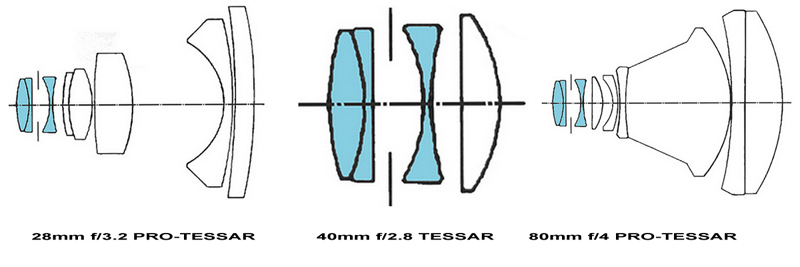
Als Standardobjektiv kommt ein Carl Zeiss Tessar 2.8/40 mm zum Einsatz, dessen Frontelement sich per Bajonettverschluss gegen sogenannte Pro-Tessare (28 mm f/3.2 und 80 mm f/4) austauschen lässt. Ein Konzept der sog. Satzobjektive, was Zeiss Ikon mit der Contaflex eingeführt, später aber wieder aufgegeben hatte. Damit hatte die Rolleiflex SL26 (hier ihre Anleitung) zwar formal Wechselobjektive, allerdings auf diese 3 beschränkt, was ihr im Vergleich zur Contaflex 126 oder zur Kodak Instamatic Reflex ein paar Punkte kostet. Apropos Kosten: Das ganze Set war wirklich nicht gerade billig: Fast $700 musste man damals dafür hinlegen, nach heutiger Kaufkraft sind das fast 4500€!
The standard lens is a Carl Zeiss Tessar 2.8/40 mm. Its front element can be replaced throgh a bayonet mount by the so call Pro-Tessars (28 mm f/3.2 and 80 mm f/4). Carl Zeiss called this concept set-lenses, introduced by Zeiss Ikon with their Contaflex series, but later discontinued again. Formally, whith this feature the Rolleiflex SL26 could claim to have interchangable lenses, but it was clearly limited to these three. In contrast to Contaflex 126 or Kodak Instamatic Reflex, which had real interchangable lenses that was a disadvantage. Despite this, the complete set was really expensive: Almost $700 you had to spend for it in the early 1970ies, which is about $5000 in today's money.

Auch heute ist die Rolleiflex noch die wertvollste der fünf SLR's. Ich habe lange auf eine günstige Gelegenheit gewartet und einige Auktionen bei ca. $100 ziehen lassen, dann aber für nur $24 bei diesem exzellenten Exemplar zuschlagen können.
Even today the Rolleiflex is still the most valuable of the five SLRs. I have waited a long time for an opportunity and let pass some auctions at about $100, but then I found this excellent copy and could get it for only $ 24. What a catch!

2015-08-14

Kodak Instamatic Reflex

This is Instamatic SLR No. 3 on the market, launched in 1968 by Kodak itself after they introduced the 126 cartridge already 5 years before. The question is, whether they ever intended to build an SLR for the format from the beginning. My believe is they did not. However, after the saw Keystone and Zeiss Ikon coming up with SLRs they remembered about their facility in Stuttgart, Germany and the well regarded line of Retina Reflex cameras they were producing over there. The result is a straight forward and easy to use camera, with a build-in CdS photo cell (not TTL though) controlling the electronic Compur leaf shutter (aperture priority automatic). The metering system sensed the film speed from the cartridge (64, 80, 125 or 160 ASA). The viewfinder displayed shutter speed, and has a focusing screen with a split-image rangefinder. Flash was either provided by Flashcubes  or you can choose to connect an external flashgun via a PC socket.
Das is Instamatic Spiegelreflexkamera Nr. 3, 1968 auf den Markt gebracht von Kodak selbst nachdem sie schon 5 Jahre zuvor die 126er Kasette eingeführt hatten. Die Frage ist, ob sie zu Beginn wirklich vorgehabt haben, eine SLR für dieses Format zu bauen. Ich persönlich glaube nicht. Aber nachdem Keystone und dann auch Zeiss Ikon welche hatten, erinnerte man sich an die Frabrik in Stuttgart und die dort produzierten sehr angesehenen Retina Reflex Kameras. Das Resultat ist eine sehr geradlinig konstruierte und einfach zu benutzende Kamera, mit einem eingebauten (nicht TTL!) CdS Belichtungsmesser, der den elektronischen Compur-Zentralverschluss steuert (Zeitautomatik). Der Belichtungsmesser ließt die Filmempfindlichkeit automatisch von den Kassetten ab (64, 80, 125 oder 160 ASA). Der Sucher zeigt die Verschlusszeit und die Mattscheibe hilft beim Scharfstellen durch einen Schnittbild-Entfernungsmesser. Geblitzt wird entweder mit by Blitzwürfeln  oder man schließt einen externen Blitz per Kabel an.
With Kodak's marketing power and the quite compelling design it became the best selling of the five Instamatic SLR's, with more than 75,000 cameras produced. Kodak sold it until 1974, although I tend to believe that they stopped production already one or two years earlier.
Certainly the biggest advantage for Kodak over its competitors was the existence of a broad range of high quality Retina-S lenses connected through the DKL-mount and available from Schneider-Kreuznach or Rodenstock. Only one lens was specifically developed for the camera and its slightly smaller image area compared to 135 film. This was the Schneider Xenar 45 mm f/2.8 and mostly sold as its standard lens for $199 (for the set with the camera).
Mit Kodak's Marktmacht und dem ansprechenden Design wurde die Kamera zur bestverkauften von den fünf 126er SLR. Mehr als 75000 Einheiten wurden bis 1974 verkauft, auch wenn ich glaube, dass die Produktion schon ein oder zwei Jahre früher aufgegeben wurde.
Kodak's sicherlich größter Vorteil den Wettbewerbern gegenüber war die Existenz einer breiten Palette hochwertiger Retina-S Objektive, die über das Deckel Bajonett Anschluss fanden und entweder von Schneider-Kreuznach oder Rodenstock kamen. Ein einziges Objektiv wurde speziell für die Kamera (und ihre im Vergleich zu KB geringfügig kleinere Filmfläche) gebaut. Das war das Schneider Xenar 45 mm f/2.8, was auch meistens als Standardobjektiv mit der Kamera zusammen für $199 verkauft wurde.

Actuall, I found this camera already three years ago on an antique market for just $10. However, it was missing a lens and I always wanted to present it here with its 45mm f/2.8 Xenar. It turned out, that it wasn't easy to find one at a decent price. Therefore, here it comes with the super-wide Curtagon for the moment. When I'll finally find the standard lens, I promise to update this post and add more pictures as well.
Ich habe diese Kamera schon vor drei Jahren auf einem Trödelmarkt für nur $10 erstanden. Allerdings fehlte ein Objektiv und ich wollte mit dem Posten hier warten bis ich das Xenar irgendwo aufgetrieben hatte. Es stellte sich aber bisher als schwierig heraus, ein solches zu einem anständigen Presi zu erweben. Daher kommt die Kamera jetzt hier in meiner kleinen Serie mit dem "Superweitwinkel" Curtagon. Wenn ich dann mal irgendwann ein Normalobjektiv gefunden habe, verspreche ich hier diesen Beitrag zu überarbeiten und auch noch mehr Bilder zu zeigen.

2015-08-07

Zeiss Ikon Contaflex 126


This is Instamatic SLR No. 2, launched on the market in 1967. A world of a difference to No. 1 (Keystone K 1020) in almost every way. The Contaflex plays technically (and price wise) in the top league. One last time, with this camera Zeiss Ikon has proved what German camera technology was capable of. However, it will remain a mystery to me why they've chosen to build the camera around the lousy Instamatic cartridge with its known poor film flatness.
Hier ist also Instamatic-Spiegelreflex Nr. 2, auf dem Markt erschienen 1967. Krasser konnte der Unterschied zu Nr. 1 (Keystone K 1020) in fast jeder Hinsicht nicht ausfallen. Die Contaflex spielt technisch (und preislich) in einer anderen Liga. Ein letztes Mal hat Zeiss Ikon mit dieser Kamera bewiesen, was deutsche Kameratechnik ist. Mir bleibt es allerdings ein Geheimnis, warum sie die Kamera um die 126er Kassette mit ihrer lausigen Film-Planlage herumgebaut haben.

Interestingly, the Contaflex is the only of the five Instamatic SLRs, which has a focal plane shutter. This is particularly remarkable since the previous Contaflex series was famous for its highly complex leaf shutter systems. Otherwise the thing is like a strange compromise of fine high-tech works  and simplifications for the camera laity, like the weather icons on the shutter speed dial, the shutter priority autoexposure and of course the 126 cartridge itself.
Interessanterweise ist die Contaflex die einzige der fünf Instamatic Spiegelreflexen, die einen Schlitzverschluss hat. Das ist besonders bemerkenswert, da die bisherige Contaflex Serie fast demonstrativ den Zentralverschluss der Konkurrenz entgegengehalten hatte. Ansonsten wirkt das Ding wie ein seltsamer Kompromiss aus edlem High Tech und Vereinfachungen für den Kameralaien, wie die Wettersymbole bei den Verschlusszeiten, der Blendenautomatik und natürlich die 126er Kassette selbst.

4 years ago I already posted about a Contaflex 126, without having possessed it (why is in the post). Now I finally got one, even in excellent state of preservation. The technical details I will later summarize in a table facing the other 126er SLR's (yes I now have all five of them, and will post here in chronological order the next few weeks). This thing has cost me $ 40 plus postage, nothing against the $ 160 that was requested in 1967 (in today's purchasing power about $1,200). But collectors still pay up to $ 300. Finally, the link to the manual and a look through the viewfinder ...
Vor 4 Jahren habe ich schonmal eine Contaflex 126 hier gepostet, ohne sie besessen zu haben (warum steht im Post). Jetzt hab ich endlich eine, sogar in exzellent erhaltenem Zustand. Die technischen Details werde ich später mal tabellarisch den anderen 126er SLR's gegenüberstellen (ja ich habe inzwischen alle fünf, die ich in historisch chronologischer Reihenfolge hier in den nächsten Wochen bringen werde). Das Ding hat mich $40 plus Porto gekostet, nichts gegen die $160, die man 1967 dafür verlangt hat (nach heutiger Kaufkraft ca. 1000 Euro). Aber auch heute noch zahlen Sammler bis zu $300 dafür. Zum Schluss noch der Link zur Anleitung und ein Blick durch den Sucher...

2015-08-02

Keystone K 1020 auto-instant Reflex

Die erste Spiegelreflexkamera (SLR) für Kodak's Instamatic Kassette (126er) kommt formal aus den USA, aber eben nicht von Kodak selbst. Im Juni 1966, drei Jahre nachdem der gelbe Riese die 126er Kassette auf den Markt brachte, war es Keystone, die Nummer 3 auf dem amerikanischen Kameramarkt (nach Kodak und Polaroid), die als erste schalteten und die immer populärer werdende SLR mit der Kassette paarten. Keystone war eher im Einfachkamera-Massenmarkt aktiv und ließ die Kamera von Mamiya in Japan produzieren. Hierbei griff man wohl auf einige Elemente der Auto-Lux 35 zurück. Obwohl die erste von fünf 126er SLR auf dem Markt, blieb sie mit unter $100 Kaufpreis (1967) immer die preiswerteste.
The first single lens reflex (SLR) for Kodak's Instamatic 126 cartridge comes formally from the US, but not by Kodak itself. In June 1966, three years after the yellow giant launched the 126 cartridge on the market, it was Keystone, number 3 of the US camera market (behind Kodak and Polaroid) to first pair the increasingly popular SLR concept with the instant loadable cassette. Keystone was rather active in the mass market for simple cameras and used Mamiya in Japan as a toll producer. Some elements of the Auto-Lux 35 might have been re-used. Although the first of total five 126 SLR's on the market, it always remained the cheapest with less than a $100 price tag (1967).
Die Kamera selbst ist höchst simpel und hat sogut wie keine Bedienelemente. Für's Filmeinlegen, Scharfstellen und Auslösen braucht es eigentlich keine Anleitung, auch der Sockel für den Sylvania-Blitzwürfel ist idotensicher. Die Blendenautomatik (mit Nadelanzeige im Sucher) wird vom Selenelement gesteuert, es gibt nur eine Verschlusszeit (die nirgends genannt wird, vermutlich 1/80 s). Die Anleitung verrät, dass zum Blitzen eine andere Verschlusszeit verwendet wird (aber wieder nicht welche, hier vermute ich 1/40 s). Zum Zünden der N-Blitzwürfel werden zwei Alkalibatterien der Größe N gebraucht, ansonsten funktioniert die Kamera auch ohne Batterie. Das Objektiv (48 mm f/2.8) ist vermutlich baugleich mit dem entsprechenden Mamiya Sekor, ein recht anständiges Triplet.
The camera itself is very simple and has almost no controls. Film loading, focus and shoot don't really require a manual, also the socket for the Sylvania flashcubes is fool-proof. The shutter priority automatic (with needle indicator in the viewfinder) is controlled by the selenium element, there is only one shutter speed (which is mentioned nowhere, probably 1/80 s). The manual reveals a different shutter speed for flash photography (but again not which, I'm guessing here 1/40 s). To ignite the N-flashcubes two alkaline batteries of size N are needed, otherwise the camera works without. The lens (48 mm f/2.8) is probably identical to the corresponding Mamiya Sekor, quite a decent Triplet.

Keystone selbst ist während der Bauzeit der K 1020 an Berkey Photo verkauft worden und danach von Boston, MA nach Clifton, NJ umgezogen. In den 70ern konnte man zunächst seinen Marktanteil steigern, dann aber nicht mehr gegen den Giganten aus Rochester mithalten. Nach weiteren Verkäufen stand 1991 die Pleite. Der Machtkampf mit Kodak wird in einem Artikel über Benjamin Berkey blumig beschrieben, ich habe seinem Sohn Harvey schon vor Wochen eine e-mail geschrieben, mit der Hoffnung weitere Details zur K 1020 zu erfahren, aber erfolglos. So wird es wohl ein Geheimnis bleiben, wie erfolgreich die Kamera am Markt war und wieviele Exemplare verkauft wurden. Mein Exemplar hat mich $6 plus Porto gekostet, laut Collectiblend ist es wohl ein bisschen mehr wert.
During production of the K 1020 Keystone itself was aquired by  Berkey Photo and then moved from Boston, MA to Clifton, NJ. During the 70's they first increased their market share, but eventually they lost the competition against the giants from Rochester. After further owner changes they filed for bankruptcy in 1991. The fight with Kodak has been described in an article about Benjamin Berkey quite flowery. I wrote an e-mail to his son Harvey with some hope to find out further details about the K 1020, but without success. Therfore, it will probably remain a mystery how successful the camera was and how many copies were sold. My copy has cost me $ 6 plus freight, according to Collectiblend it is probably worth a little bit more.

2015-07-29

Post #267


Ich bin immer wieder erstaunt meinen hundertsten Post ganz oben in den Wochencharts zu sehen. Insgesamt steht er beliebtheitsmäßig für Zeit meines Blogs (laut Google's Statistik) auf Platz 74 von nun insgesamt 267 Posts. Ich bin aber auch erstaunt, wie leer das Regal vor 4 Jahren noch war. Inzwischen ist es ganz leer, denn meine Sammlung ist auf dem Weg nach Deutschland. Aber bevor die Kameras und das Zubehör in die Kartons kamen, habe ich zu Dokumentationszwecken noch ein Foto gemacht (siehe Bild oben). Vermutlich werden sie einige Monate, wenn nicht sogar länger in diesen Kartons bleiben, denn ich muss erstmal wieder einen Platz schaffen, wo sie gebührend präsentiert werden können. Für die nächste Zeit habe ich aber vorgesorgt und schon einige Bilder gemacht, die in dieser Übergangsphase über neue Exemplare etc. gepostet werden. Auch werde ich natürlich nicht aufhören weiterzusammeln.
I'm always surprised to see post #100 ("meinen hundertsten Post") on top of the week charts. For the entire time of my blog it's on position 74 out of now 267 (according to Google's statistics). However, even more surprised I am about how empty the shelves were four years ago. In the meantime the rack is entirely empty, the collection is on its way to Germany. Before the cameras and all the other photo stuff were packed I took this picture above for the purpose of documentation. Supposedly they will stay boxed for a couple of month or even longer. First I need to find and create a place where they can be presented condignly again. However, for the next months I've prepared myself with pictures and topics to blog here. In addition, I will of course not stop to collect. Let's see what comes up...

2015-07-27

Olympus OM-D M5 Mark II


Nach fast 5 Jahren mit meiner E-PL1 habe ich mir spontan ein neues Gehäuse für meine Micro 4/3 Objektive gekauft (oben mit meinem Liebslingsobjektiv). Ich hatte schon länger mit was Neuem geliebäugelt, allerdings hat mich die Vielfalt von Olympus' und Panasonic's Angebot in letzter Zeit eher dazu gebracht, noch auf "die Richtige" zu warten. Ich hatte nach dem Erscheinen der zweiten Version der M5 von deren Vorzügen gelesen, insbesondere gefiel mir, dass sie viele Features der deutlich teureren M1 hat, aber ohne klobigen Handgriff. Meine Kamera sollte wie meine alte höchst kompakt, leicht und dennoch handlich sein. 
After almost 5 years with my E-PL1 I spontaneously bought a new body for my micro 4/3 lenses (see picture with my favorite lens). I considered bying something new for quite some time, but the diversity of Olympus' and Panasonic's offerings rather triggered me to wait for "the right thing". I've read about the M5 Mark II's advantages, especially liked that it inherited many features from the more expensive M1, but not the chunky handgrip. My camera had to be highly compact, lightweight and easy to handle, like the old one.
Und so ging ich also einen Tag vor meinem Urlaub in einen der wenigen verbliebenen echten Fotoläden (dieser hier war's), eigentlich nur um ein Ladegerät für die Akkus der E-PL1 zu kaufen. Und da bekam ich die "Mark II" in die Hand, war sehr angetan von ihrer geringen Größe (sie wirkt auf allen Fotos größer als sie wirklich ist), vom exzellenten Sucher (elektronic Viewfinder, 2.36 Megapixel) und auch sonst vom ganzen "Feature set". Ich möchte hier keinen ganzen Review schreiben, hier ist was mir davon am Besten gefällt und was mich letztlich überzeugt hat: 
And so, one day before my vacation I went in one of the few remaining true photo shops (this one), actually just to buy a charger for the battery of the E-PL1. And since I got the "Mark II" in the hand, I was very impressed by its small size (it looks larger on pictures than it really is), the excellent viewfinder (Electronic Viewfinder, 2.36 megapixels) and really the entire feature set. I don't want to write a comprehesnive review. Here's what I like most and what eventuately convinced me:
  • Bedienlemente ('Controls') sind sehr vielfältig und sehr überlegt designt. Vieles kann man sich an seinen eigenen Geschmack per Software anpassen. Ich habe so zwei Tage lang mit den Einstellungen gespielt, bis ich was gefunden habe, wo alle wesentlichen Funktionen nur einen Knopfdruck oder Drehrad entfernt sind. Hut ab, Olympus! Die beiden zentralen Drehräder verstellen sich einen Ticken zu leicht von selbst, dafür ist das Touch Display eine wahre Wonne (z.B. um den Schärfepunkt zu setzen).
  • The controls are manyfold and deliberately designed. Many settings can be adapted to own taste via software. I played for two days with the menu settings until I found something, where all essential functions for me are just a push of a button or scroll wheel away. Kudos to Olympus! The two central wheels dissemble a tick too easily by itself, but the touch screen (eg to set the focus point), a sheer delight.
  • Wifi (WLan) Anbindung ans Smartphone. Die Bedienung ist zwar etwas holprig und könnte nach meinem Geschmack Apple typisch simpler gestaltet sein, aber es funktioniert. Zum einen kann man das Smartphone als GPS Logger benutzen, so erhalten beim Synchronisieren alle Fotos ihre Koordinaten in die EXIF Datei geschrieben. Zum anderen lädt man die schönsten Fotos oder Videos einfach auf's Fon runter und ruckzuck ins soziale Netzwerk rauf. Fast hätte ich es vergessen: Mit der App auf dem Fon kann man natürlich auch die Kamera fernsteuern, inklusive Live-View auf dem Display.
  • WiFi connection to the smartphone. The usage and setup might be a bit bumpy and could for my taste be designed more straight forward (Apple like), but it works. On the one hand you can use the smartphone as a GPS logger. After synchronizing all the photos get their coordinates written into the EXIF file. Secondly, you simply load the best photos or videos down to the phone and then up into any social network. I almost forgot: With the app on the phone you can remotely control the camera, including Live View on the display.
  • Schicke neue Fotofunktionen per Software, die (endlich) ihren Weg in die Kamera gefunden haben: (A) Keystone-Korrektur. Mir war gar nicht klar, dass ich sowas vermisst habe. Ein kleiner Druck auf den Knopf und Anpassen mit den Drehrädern ersetzt ein teures Tilt/Shift-Objektiv. (B) HDR in der Kamera, kann mein iPhone schon lange und vermisse ich schon viel länger. Die Kamera schießt dazu in schneller Folge (bis 10 pro Sekunde) eine Serie von gleichen Fotos mit unterschiedlicher Belichtung und rechnet danach ein Bisschen. Details lassen sich anpassen. (C) Zweifach-Telekonverter per Software. Kennt man von Billigknippsen und verringert die Auflösung, aber es gibt Situationen, in denen man schon während des Fotografierens die Ausschnittvergrößerung vornehmen will. Sehr vermisse ich immer noch (D), Panorama! Es gibt zwar einen Panorama-Modus, der zeigt aber nur die Hilfslinien an für das Überlappen der Teilbilder. Zusammensetzen muss man diese aber immer noch mit externer Software. Auf die Hilfslinien kann ich schon lange verzichten.
  • Neat and new features via software (finally) found their way into the camera: (A) Keystone Correction. I did not realize that I missed that. A little push on the button and some adjustments with the wheels replaces an expensive tilt / shift lens . (B) HDR in camera, my iPhone can do this for a long time and I miss this even longer. The camera shoots a series of the same object with different exposures in burst mode (up to 10 per second),  and then calculates a bit. Details can be customized. (C) 2x tele-converter via software. Known from cheap consumer cameras and reduces the resolution, but there are situations where one wants to do the cropping already during shooting. Very much I still miss (D), in camera panorama! Although there is a panorama mode, but this shows only guiding grid lines on the display. Final stitching must still be done with external software.
  • Vom 16MP Sensor mit 5-Achsen Anti-Wackel und dem neuen und bisher in einer Consumerkamera einzigartigen 40 MP HighRes Modus will ich gar nicht sprechen, weil ich dazu noch mehr ausprobieren muss. Toll zu wissen, dass die Bildqualität sich mit größeren Sensoren messen will (und kann!). Ein totales Killerkriterium war es für mich nicht.
  • I don't want to talk about the 16MP sensor with 5-axis anti-shake and the new and unprecedented  40 MP HighRes mode (in a consumer camera). I have to test this first in more extend. Great to know that the picture quality will (and can!) challenge larger sensors. However, this was not killer criterion for me.
Alles in allem genug für mich für mein Upgrade, was mir vom Fotohändler durch eine $200 Sommer-Rabbat-Aktion noch schmackhafter gemacht wurde. Nach zweieinhalb Wochen ausgiebigem Testen im Urlaub muss ich sagen: die $899 waren gut angelegtes Geld! 
All in all, enough convincing to do the upgrade. The photo dealer eased the decision by a $200 Summer Rebate initiative. After two and a half weeks copious testing during vacation I have to conclude: The $ 899 was money well spent!